Monday, April 27, 2015

Funnel Flaps Working, Construction and regulations

Funnel flaps in a ship refers to the movable closures or windows present in the aft head of the funnel ( generally). Light weight gases from the engine room escapes to the outer atmosphere through the grills in the funnel or the funnel flap openings.

Hydraulic or pneumatic arrangements are provided for closing and opening the funnel flaps. By regulation, the funnel flaps should have provisions to be opened from a remote location. Usually, Fire control stations houses the remote control arrangements for funnel flap operation.

Funnel flaps are to be closed before releasing of C02 or doing a composite boiler or exhaust gas boiler cleaning by pressurizing the engine room.

Funnel flaps are to be always kept clean and lubricated well, It is a main component of the engine room, a favourite choice of psc inspectors and various other surveyors. A poorly maintained funnel flap will invite bad reports and will pose a serious threat to safety of the engine room.

It is a part of saturday routines to check the remote and local operataion of the funnel flaps , and is usually done by the fourth engineer or third assistant engineer. 

Wednesday, April 22, 2015

Fire Cabinet or Fire Box- Contents

Fire box contains the following items

1. Fire hose

2. F-Spanner for opening the hydrant valves

3. Nozzle- Either Standard or Dual purpose;  Standard nozzles will produce only jets, whereas dual purpose nozzles will produce both jet as well as Spray depending on the position of the turn key.

4. Hook spanner

5. Instructions pasted on the box

Difference between purifier and clarifier- GRAVITY DISC

1. The presence of a gravity disc in the purifier- There is a general misconception that gravity disc generates the interface between oil and water in the purifier. this is not correct. Interface is formed dude to the centrifuging action, the lighter oil particles will be in the central portion and the heavier water and sludge particles will move to the outer periphery. Thus, What is gravity disc doing here??? NOTHING.! Gravity disc is just giving a surface of seperation between oil and water flow.  In alfa laval alcap purifiers which are newer models of the renowed manufacterer, There is no gravity disc present. Instead of gravity disc a water in oil detector is used. 

2. Clarifier has a sealing ring wich seals the water outlet, as water and impurities remain in the until desludging. 

3.The conical discs in a clarifier usually don’t have feed holes in them but if they do, then a disc without any holes is fitted at the bottom of the stack.

4. Sealing water is not present in clarifiers for the generation of a seal that prevents the oil to leave through the water outlet at starting. Purifiers and Clarifiers differ only in that clarifiers are not set up to remove water.

Gangway safeties in ships. Things to be checked before using the gangway.

The accommodation ladder and gangway must:

1. be firmly secured to the bulwark;

2. be properly aligned with the means of access to the vessel;

3. have treads that are at least 600 mm in width and 200 mm in depth, with a permanent non-slip surface;

 4. be equipped with two handhold stanchions that are not less than 40 mm in diameter;

5. extend not less than 1.2 m above the top of the bulwark;

 6. be fitted at the point of boarding or disembarking the vessel not less than 700 mm and not more than 800 mm apart.

 Every accommodation ladder and gangway must:

1. be maintained in a safe condition;

2. be installed in a manner that reduces movement;

3. be suitably rigged and maintained to compensate for the movement of the vessel;

 4. be adequately lighted;

5. as far as practicable, be not be more than a 40° angle to the horizontal plane;

6. be provided with a lifebuoy that has an attached line and is strategically placed and ready for immediate use; and

 7. have the mechanical, electrical, gearing, hydraulic and pneumatic systems in good working order.

Freeboard explained ,and why it is given.

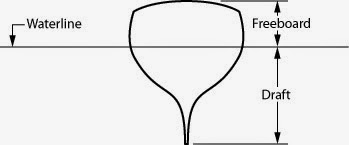
In sailing and boating, free board means the distance from the waterline to the upper deck level, measured at the lowest point of sheer where water can enter the boat or ship.

Freeboard defines the reserve bouyancy of a vessel. It is to be there to satisfy the reserve bouyancy regulations by IMO and other conventions. Reserve buoyancy is important for the vessel’s safe operation at sea.

Sufficient free board is required at all times to prevent the vessel being swamped and overwhelmed. For ocean going vessels, it is important to note that those structures above the waterline that are not watertight will not contribute to the reserve buoyancy of the vessel. Again, this makes sense – an open wheelhouse, or a cabin with the doors left open will not offer much protection if the vessel begins to ship water over the side.

Another factor affecting the freeboard to take into account is the trim of the vessel. Trim is defined as the difference between the draft forward and the draft aft. Draft is the depth of the hull below the water. If the aft draft is greater, the vessel is described as being trimmed by the stern, if the forward draft is greater, she is trimmed by the bow.

Length between perpendiculars and its Significance

Length between perpendiculars, often abbreviated as p/pp.p.ppLPPLBP or Length BPP is a term describing the length of a ship. LBP refers to the length of a vessel along the waterline from the forward surface of the stem, or main bow perpendicular member, to the after surface of the sternpost, or main stern perpendicular member. When there is no sternpost, the centerline axis of the rudder stock is used as the aft end of the length between perpendiculars.

Measuring to the stern post or rudder stock was believed to give a reasonable idea of the ship's carrying capacity, as it excluded the small, often unusable volume contained in her overhanging ends. On some types of vessels this is, for all practical purposes, a waterline measurement. In a ship with raked stems, naturally that length changes as the draught of the ship changes, therefore it is measured from a defined loaded condition.

The significance lies in the fact that this length gives the length of the waterline of the vessel, in loaded condition, a very crucial parameter.

Tuesday, April 21, 2015

Annex 1 discharge criteria outside special area and inside special area for marine vessels

Inside special areas or outside special areas within 50 nm


ANY DISCHARGE IS PROHIBITED with the exception of clean or segregated ballast

Outside Special areas: 


ANY DISCHARGE IS PROHIBITED, with the exception of clean or segregated ballast, or except when:

1. the tanker is proceeding en route, and

2. the instantaneous rate of discharge of oil does not exceed 30 litres/nm, and

3. the total quantity of oil discharged into the sea - does not exceed - for tankers delivered on or before 31 December 1979 - 1/15,000 of the total quantity of the particular cargo of which the residue formed a part - and - for tankers delivered after 31 December 1979 – 1/30,000 of the total quantity of the particular cargo of which the residue formed a part, and

4. the tanker has in operation an oil discharge monitoring and control system and a slop tank arrangement as required by regulations 29 and 31, respectively